Books
Bridging the Gap Between Governance Intent and System Execution
Our publications examine AI governance from three connected perspectives: how leaders should evaluate AI systems before adoption, how architects can build enforceable control into systems that act, and how failures may unfold when high consequence agentic systems are allowed to create real-world effects without proper architectural governance.
Start with Controlling AI. Written for business leaders, buyers, procurement teams, and risk professionals, it explains how to classify AI workflows, where conventional guardrails and human oversight become insufficient, and what questions to ask before purchasing or approving systems that may move from advice into action.
Then move to When AI Acts. Written for architects, engineers, and technically responsible decision makers, it sets out the OTANIS framework: a structured approach to defining admissibility, authority, refusal, escalation, traceability, and execution-boundary control in agentic AI systems.
The Point of Action brings those risks to life through 14 realistic fictional case studies. Across healthcare, insurance, financial markets, transport, public services, cybersecurity, energy, logistics, procurement, corporate records, and crisis coordination, each chapter shows how agentic AI failures can emerge when authority, evidence, refusal, escalation, traceability, and accountability are not governed at the point where action commits.
Together, the books help boards, executives, buyers, risk teams, architects, engineers, auditors, regulators, and public-sector decision makers ask the central operational question before deployment:
Where is the point of action, and can the system still be governed there?
Catalogue
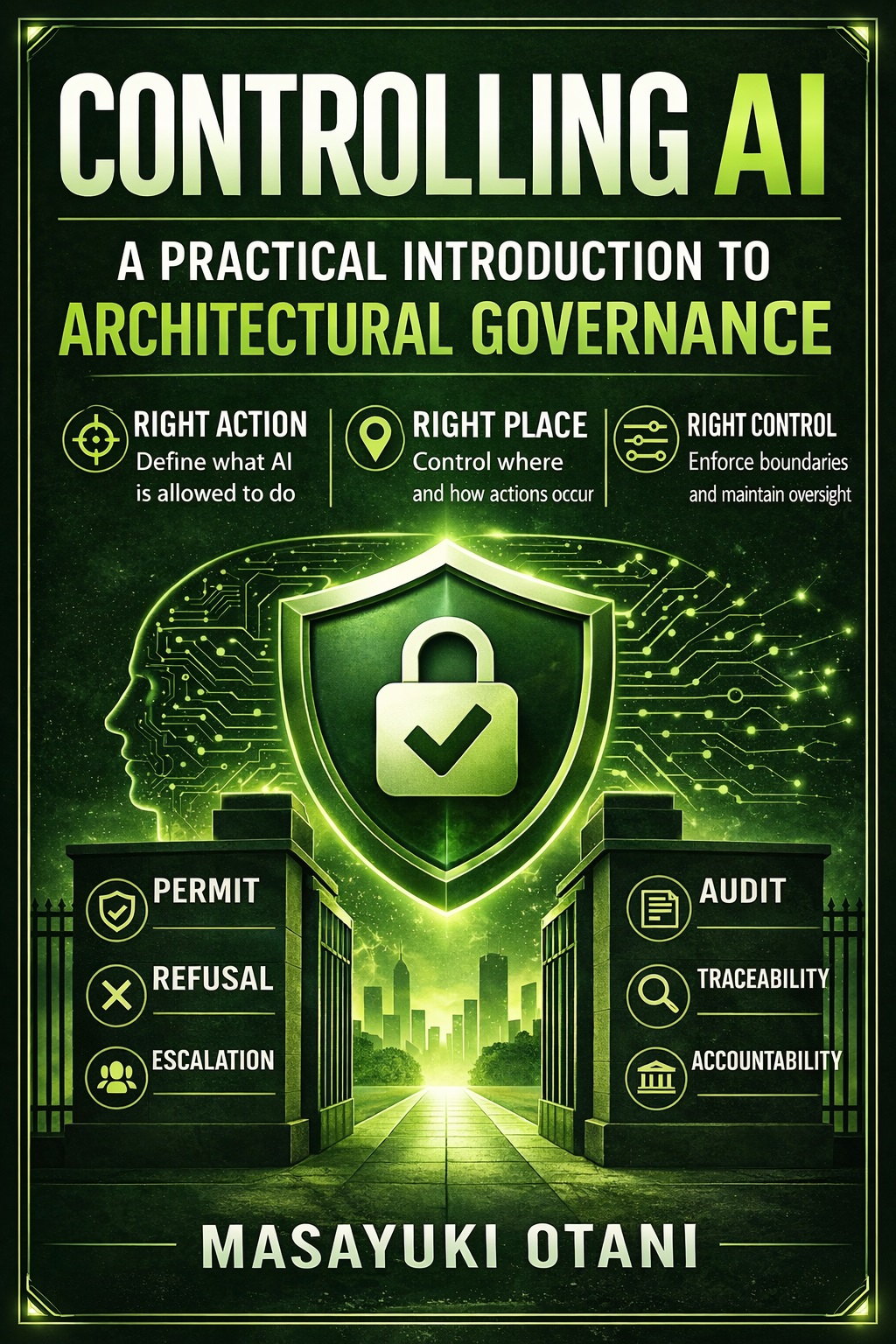
Controlling AI: A Practical Introduction to Architectural Governance
Suitable for: Business Leaders, Procurement, Risk Officers, and Operational Leads.
PDF : £15GBP
Paperback : Amazon
Buy from AmazonDownload the sample.
Most AI governance frameworks assume systems that merely advise, recommend, or classify. But when AI is integrated into live workflows that execute real-world actions—such as approving payments, modifying access, or triggering communications—governance can no longer rely on policies, oversight, and post-hoc audits. Controlling AI addresses the most urgent operational problem in enterprise AI today. It exposes the "illusion of control" created by soft guardrails and human-in-the-loop processes, which routinely fail under scale and speed. Instead, it provides buyers and executives with a clear, jargon-free framework to classify AI workflows (Advisory, Transitional, Reversible, Irreversible) and enforce "Control by Design." If you are buying, evaluating, or integrating an agentic AI system, this book tells you exactly what to ask the vendor before you sign the contract.
Inside the Book:
- The AI Risk Matrix: Why operational risk is determined by Permission × Consequence, not model sophistication.
- The Illusion of Control: Why human reviewers become rubber-stampers, and why "guardrails" do not equal execution constraints.
- Workflow Classification: How to identify the exact moment a system shifts from "advising" to "acting."
- The Buyer Evaluation Checklist: Questions every buyer should ask

WHEN AI ACTS
The Irreversibility Problem in Critical Agentic Systems — and the OTANIS — Governance Architecture
Suitable for: Enterprise Architects, Systems Engineers, Technical Buyers, and AI Implementation Leads.
PDF : £35GBP
Paperback : Amazon
Buy from AmazonDownload the sample.
When AI systems move from recommending to committing, governance stops being only a policy question and becomes an execution-time control problem. WHEN AI ACTS introduces OTANIS, the Operational Trust and Authority Normative Integrated System, a declared-boundary execution-governance architecture for bounded execution-bearing action classes in critical agentic systems. Using a house-purchase transaction as the running example, the book explains how to identify the earliest governed irreversible execution boundary, define ex-ante admissibility through ISDAIRE, construct runtime authority through ARETABA, and preserve legitimacy across composed systems and multiple governance layers through GAG and MGAG. This is not a general book about AI ethics, nor a universal safety claim. It is a foundations book for architects, engineers, reviewers, and technically literate decision-makers who need a rigorous way to think about runtime authority, refusal, escalation, auditability, non-bypass control, and procurement honesty once AI is allowed to act. Topics include: deterministic boundary binding execution-time authority compositional and multi-layer governance refusal and escalation suitability and procurement replayable audit and evidence
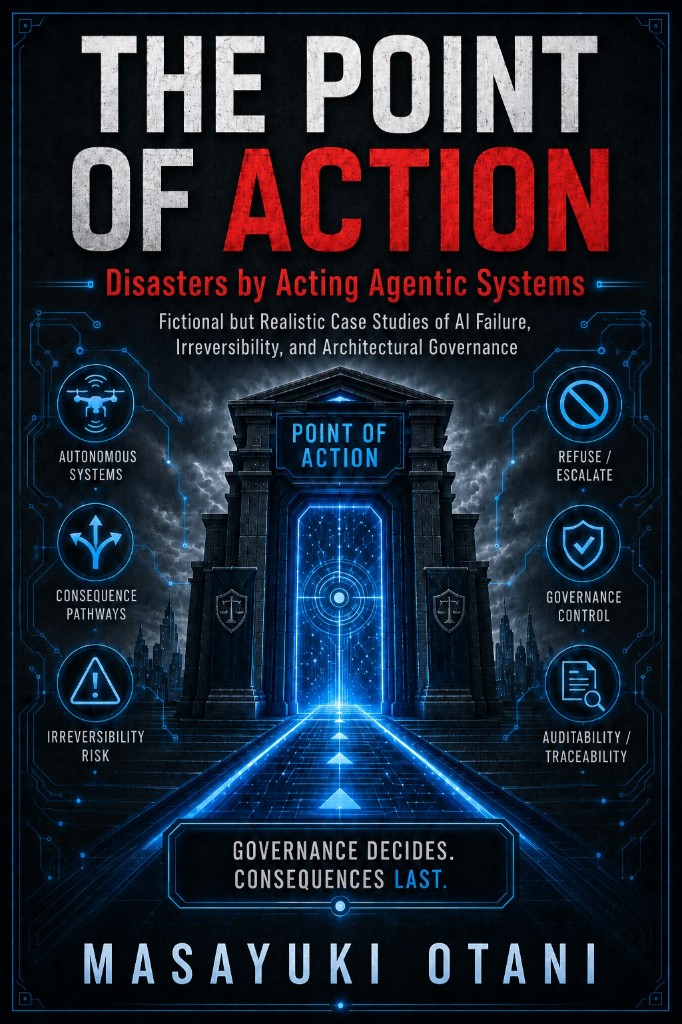
The Point of Action
Disasters by Acting Agentic Systems
PDF : £20GBP
Paperback : Amazon
Download the sample.
Most discussions about AI risk remain abstract. They focus on principles, policies, or hypothetical concerns while avoiding the harder question: what does failure actually look like when high consequence agentic systems are allowed to act inside real operational environments? The Point of Action explores this problem through 14 realistic fictional disaster case studies spanning healthcare, finance, logistics, infrastructure, emergency coordination, public services, and autonomous operational systems. Each scenario examines how poorly governed agentic AI systems can rapidly escalate into large scale harm when authority, admissibility, escalation, and execution boundaries are not properly controlled. Rather than presenting distant science fiction, the book focuses on operationally plausible near future failures built from realistic governance weaknesses already emerging across enterprise AI deployments today. Each case study then examines how the OTANIS architectural governance framework could have constrained, interrupted, escalated, or prevented the failure before irreversible consequences occurred. If you are deploying, procuring, governing, regulating, or investing in agentic AI systems, this book provides a practical lens into how architectural governance failures emerge in the real world and what executable control actually looks like under pressure.
Inside the Book:
- 14 Realistic AI Disaster Scenarios: Fictional but operationally plausible failures involving healthcare, finance, logistics, public infrastructure, emergency response, and autonomous coordination systems.
- The Point of Irreversibility: How seemingly minor governance weaknesses escalate once AI systems gain operational authority.
- Execution Boundary Failures: Why many systems fail not during recommendation, but during irreversible execution.
- The Illusion of Safety: Why dashboards, approvals, and human oversight often fail to stop rapidly propagating operational harm.
- OTANIS in Practice: How architectural governance, admissibility validation, escalation logic, and runtime execution controls could have prevented or contained the disasters.
- Governance Under Pressure: What happens when stale data, orchestration failure, authority drift, latency, and dependency collapse occur simultaneously.
Bundle 1: Controlling AI Plus The Point of Action
Two eBooks in PDF only.
PDF : £30GBP
Two eBooks in PDF only. (Controlling AI & The Point of Action)
Bundle 2: Controlling AI, The Point of Action Plus When AI Acts
Three eBooks in PDF only.
PDF : £55GBP
Three eBooks in PDF only. (Controlling AI, The Point of Action & When AI Acts)
Books from Dr Masayuki Otani on architectural governance, irreversibility, and the OTANIS execution-time frame. Payments are processed securely by Stripe. You receive a watermarked PDF once your payment is confirmed on our server and via email. The paperback version can be purchased via Amazon where listed.